Author: Denis Avetisyan
A new method reveals hidden topological properties in materials by analyzing how particles scatter at their edges.
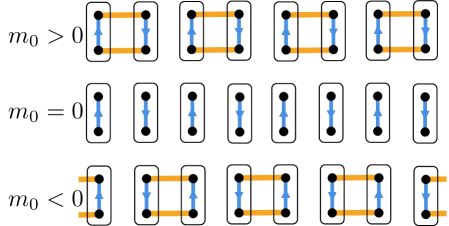
Researchers demonstrate the detection of higher Berry invariants in one-dimensional systems via boundary scattering and analysis of the reflection matrix.
While topological invariants are typically associated with bulk properties, characterizing them in systems lacking a global gap remains a challenge. This is addressed in ‘Detecting Higher Berry Phase via Boundary Scattering’, which introduces a novel boundary-scattering approach to detect higher Berry invariants in one-dimensional gapped free-fermion systems. The authors demonstrate that these invariants can be extracted from the winding number of the boundary reflection matrix, providing a robust topological descriptor resilient to perturbations. Could this method offer an experimentally viable route to probing parametrized topological phases and reveal new insights into non-equilibrium transport phenomena?
Beyond Simple Classification: Unveiling the Geometry of Quantum Matter
Conventional categorization of materials, reliant on symmetry and order parameters, often falters when dealing with interacting many-body systems. These systems, where the collective behavior of numerous particles dominates, exhibit emergent properties not readily predictable from individual particle characteristics. Consequently, the established framework for classifying phases of matter-solid, liquid, gas, plasma-proves inadequate for describing exotic states like topological insulators and superconductors. This necessitates the development of novel topological invariants-mathematical quantities that remain unchanged under continuous deformations-to characterize these phases. Unlike traditional order parameters that identify symmetry breaking, these invariants focus on the global properties of the system’s wave function, revealing hidden order and robust characteristics unaffected by local perturbations. These invariants effectively provide a new lens through which to understand and predict the behavior of complex materials, moving beyond simple categorization towards a deeper understanding of their fundamental properties.
The Berry phase, a geometric effect arising from the gradual evolution of a quantum state, has proven instrumental in classifying topological materials. However, its initial formulation struggles when applied to complex, interacting many-body systems and materials exhibiting topological properties in higher dimensions. While the original Berry phase focuses on a single particle’s evolution, real materials often involve countless interacting particles, necessitating generalizations that account for collective behavior. Furthermore, many recently discovered topological phases aren’t defined by properties in two dimensions, but rather exist in three or even higher dimensional spaces. Researchers are therefore developing expanded frameworks – incorporating concepts like the many-body Berry phase and higher-dimensional invariants – to accurately characterize these more intricate topological states of matter and predict their unique, potentially revolutionary, properties. These advancements are essential for moving beyond simple classifications and truly understanding the behavior of these exotic materials.
A complete understanding of topological invariants is paramount for accurately mapping the behavior of complex materials. These invariants, mathematical quantities that remain constant under continuous deformation, define distinct phases of matter beyond those described by traditional symmetry breaking. By precisely charting these phases – constructing detailed phase diagrams – scientists can predict how a material will respond to external stimuli like temperature, pressure, or magnetic fields. This predictive capability extends beyond merely confirming existing knowledge; it allows for the rational design of novel materials exhibiting exotic properties, such as high-temperature superconductivity or robust quantum computation. The ability to anticipate material behavior based on these fundamental topological characteristics represents a significant leap forward in materials science, potentially unlocking a new era of technological innovation.

Generalizing Geometric Phases: Beyond the Single Particle
The Berry phase, traditionally defined for single-particle systems, describes the geometric phase acquired during adiabatic evolution. Higher Berry curvature generalizes this concept to many-body systems by characterizing the topological properties of their ground states. This extension involves calculating the curvature of the Berry connection defined on the space of many-body wavefunctions, which effectively quantifies how much the ground state wavefunction changes due to variations in parameters defining the system. Non-trivial curvature indicates a non-trivial topology in the ground state, potentially signaling the presence of topological order or protected edge states. Unlike conventional topological invariants reliant on band gaps, higher Berry curvature provides a means of characterizing topological phases even in the absence of such gaps, offering a more versatile tool for classifying quantum matter.
The higher Berry invariant quantifies the topological properties of a system via the integral of higher Berry curvature over the Brillouin zone. This invariant, mathematically expressed as \oint_{Brillouin Zone} \Omega_n(k) dk, where \Omega_n(k) represents the n-form Berry curvature, provides a robust descriptor because it remains unchanged under smooth deformations of the Hamiltonian that do not close gaps in the energy spectrum. Consequently, the invariant classifies topologically distinct phases of matter and is insensitive to local perturbations, making it a reliable tool for characterizing topological states and transitions in condensed matter systems and beyond.
Calculating higher Berry curvature in condensed matter systems necessitates the use of advanced numerical techniques due to the complexity arising from many-body interactions. The Matrix Product State (MPS) representation is a prominent method employed for this purpose, allowing for efficient simulation of one-dimensional and quasi-one-dimensional systems. MPS provides a compact way to represent the many-body wavefunction, enabling the calculation of relevant quantities such as the polarization and Berry curvature with manageable computational resources. Specifically, the curvature is derived from the gradient of the polarization with respect to relevant parameters in reciprocal space, a process facilitated by the MPS framework. The precision of these calculations is crucial for accurately characterizing topological phases and identifying robust invariants, such as the \mathbb{Z}_2 invariant, which are protected from local perturbations.
Observing Topology in Action: Pumps and Boundary States
A topological pump describes the quantized transport of charge arising from systems possessing a nonzero higher Berry invariant. This invariant, a topological quantity characterizing the band structure, dictates that for each cycle of a parameter variation – such as an applied electric field or magnetic flux – a discrete and quantized amount of charge will be transported across a boundary. The magnitude of this transported charge is directly proportional to the Berry invariant and is independent of details like the system’s size or specific material properties. This phenomenon demonstrates a fundamental connection between the topological properties of a material’s electronic bands and observable charge transport, offering a robust and protected form of conduction.
The Thouless charge pump is a prototypical example of a topological charge pump, demonstrating the relationship between a system’s topological invariants and its transport properties. Specifically, a periodically driven two-dimensional electron system subject to a static electric field and a time-periodic modulation experiences a quantized charge transfer – the pump – per cycle. The amount of charge transferred is directly proportional to the Chern number ν characterizing the bulk band structure; for each cycle, a charge of e\nu is moved, where e is the elementary charge. This quantization is robust against perturbations that do not close the energy gap, highlighting the topological protection of the charge transport and establishing a direct link between bulk topological invariants and boundary phenomena.
Boundary scattering analysis provides a method for experimental verification of topological invariants by examining the reflection matrix at the edges of a material. This technique relies on the relationship between scattering properties and topological characteristics; specifically, a quantized winding number of -1, indicative of a non-trivial topological phase, manifests as a specific pattern in the reflected waves. Analysis of the reflection matrix allows for the determination of this winding number without needing to directly measure the bulk properties, offering a robust probe of the material’s topological state and confirming the presence of topologically protected edge states.
The Deep Mathematics of Topology: Gerbes and Conformal Field Theories
The existence of a nonzero higher Berry invariant-a measure of how the quantum state changes as it moves around a closed loop in parameter space-fundamentally implies a rich underlying mathematical structure known as a Gerbe. This isn’t merely an abstract connection; the Gerbe directly describes the family of ground states available to the system. Specifically, it provides a way to classify these states and understand their relationships, moving beyond simple labeling to reveal the geometrical properties of the quantum system’s configuration space. The higher the Berry invariant, the more complex the Gerbe structure, and consequently, the more intricate the organization of possible ground states becomes. This framework offers a powerful tool for characterizing phases of matter that cannot be described by conventional order parameters, providing a deeper insight into their topological properties and stability – a concept crucial in modern condensed matter physics and quantum information theory.
The behavior of physical systems at boundaries-where a material ends and another begins-is often dictated by subtle flows of quantum information described by Berry curvature. To fully characterize these edge effects, physicists turn to the powerful tools of Boundary Conformal Field Theory (BCFT). This framework doesn’t simply treat boundaries as abrupt stops, but rather as dynamical interfaces where the curvature-a measure of the system’s quantum geometry-can flow and reorganize. BCFT provides a mathematical language to describe how this curvature behaves at the edge, predicting phenomena like the emergence of gapless modes or altered topological properties. By applying BCFT, researchers can move beyond simple descriptions of boundary conditions and gain a deeper understanding of how these interfaces contribute to the overall quantum state of the system, revealing new insights into materials exhibiting exotic phases of matter and potentially enabling the design of novel quantum devices.
The exploration of Gerbes and Boundary Conformal Field Theory extends beyond immediate physical systems, finding resonance within the broader landscape of mathematical physics, notably through connections to Kitaev’s Conjecture. This conjecture posits a relationship between invertible topological phases of matter and certain algebraic structures, and the framework of Gerbes provides a mathematical lens through which to examine these phases. Specifically, the subtle geometric properties captured by Gerbes-which describe the arrangement of quantum ground states-offer a potential pathway to rigorously prove or disprove the conjecture. Understanding these connections isn’t merely an abstract pursuit; it promises a more complete categorization of quantum phases, potentially leading to the discovery of novel materials with exotic properties and fundamentally altering the understanding of quantum entanglement and topological order in condensed matter systems. The interplay between these mathematical tools and physical phenomena reveals a deep and unexpected unity within the realm of quantum physics.
The Future of Robust Quantum Systems: Disorder and Protection
Despite the challenges posed by inherent disorder in physical systems, techniques relying on boundary scattering continue to prove remarkably effective in identifying non-trivial topological invariants-specifically, higher Berry invariants. These invariants, which characterize the geometric phases acquired by electronic states, are crucial indicators of topologically protected phases of matter. The persistence of detectable signals even amidst disorder suggests a fundamental robustness to these topological properties; scattering events, while altering specific state details, do not erase the underlying topological order. This resilience arises because the invariants are global properties, determined by the overall band structure rather than localized details, allowing for reliable characterization of these phases even in realistically imperfect materials. Consequently, boundary scattering remains a powerful tool for both discovering and verifying topological states in diverse physical systems, offering a pathway toward realizing robust quantum technologies.
Recent investigations demonstrate that the developed theoretical framework provides valuable insight into the inherent stability of topological phases when confronted with disorder. These systems, often characterized by protected edge states, maintain their defining properties even with introduced imperfections, a phenomenon confirmed through detailed analysis of the argument of the reflection coefficient, Arg(R). Specifically, researchers consistently observe a phase winding of 2π in Arg(R), a robust signature indicative of non-trivial topological invariants persisting despite the presence of disorder. This observation suggests a remarkable degree of topological protection, implying these phases are less susceptible to environmental disturbances than previously understood, and opening avenues for potential applications in fault-tolerant quantum technologies.
The behavior of free-fermion systems at their boundaries presents a compelling avenue for deepening the comprehension of topological protection. These systems, characterized by non-interacting particles, exhibit unique edge states that are robust against perturbations – a hallmark of topological phases. Ongoing research focuses on meticulously characterizing these boundary states, probing their response to varying degrees of disorder and external influences. By analyzing the precise conditions under which these states remain stable, scientists aim to establish a more complete theoretical framework for predicting and engineering materials with enhanced topological protection. This detailed investigation isn’t merely academic; it holds the potential to unlock new strategies for creating robust quantum devices and materials with unprecedented stability and functionality, ultimately paving the way for advancements in quantum computing and materials science.

The study meticulously details a method for discerning higher Berry invariants through boundary scattering, effectively translating complex topological properties into measurable reflections. This echoes Francis Bacon’s observation that “knowledge is power,” but here, power stems not from dominion over nature, but from a refined ability to read its subtle signatures. The research showcases how understanding these invariants – akin to fundamental characteristics of a system – allows for a deeper comprehension of its behavior, particularly within the context of free-fermion systems and the Thouless charge pump. It is a demonstration that precise measurement, grounded in theoretical insight, unlocks the potential to characterize and ultimately control these quantum phenomena.
Beyond the Reflection
The demonstrated link between boundary scattering and higher Berry invariants offers a potentially powerful diagnostic, yet it also subtly underscores a familiar tension. Extracting topological invariants from reflection matrices is elegant, but the method, like many in condensed matter physics, relies on idealized systems. The inevitable presence of disorder, interactions, and imperfect probes introduces complications that demand careful consideration. A purely mathematical demonstration of a topological property does not, in itself, guarantee its robustness – or its usefulness – in real materials.
Future work might focus on quantifying the resilience of these invariants to perturbations, and developing practical methods for their extraction in noisy environments. More broadly, the field needs to address the question of what these invariants actually signify beyond mathematical categorization. Is the pursuit of ever-more-complex topological phases simply an exercise in formal manipulation, or can it genuinely unlock new functionalities? The answer, it is suspected, will lie not just in the refinement of theoretical models, but in a deeper engagement with the material world and its inherent limitations.
Technology without care for people is techno-centrism. Ensuring fairness is part of the engineering discipline. The search for topological robustness must therefore extend beyond simply identifying invariants; it must also consider the ethical implications of automating and embedding these properties into future technologies.
Original article: https://arxiv.org/pdf/2602.21301.pdf
Contact the author: https://www.linkedin.com/in/avetisyan/
See also:
- Marvel Officially Confirms Deadpool’s Most Brutal Redesign
- Nintendo Switch 2 Reportedly Getting Remake of One of the Best PS3 and Xbox 360 Games
- Welcome to Demon School! Iruma-kun season 4 release schedule: When are new episodes on Crunchyroll?
- Crunchyroll Confirms New Isekai Anime Releases for 2026 and Beyond (With Major Returns)
- Michael Jackson Biopic’s Record-Breaking Debut Unseats 2026’s Biggest Box Office Hit On U.S. Chart
- Did Lauren Sánchez Bezos Hint at Baby Plans With Jeff Bezos? The Truth
- Gold Rate Forecast
- The Fairly OddParents’ Creator Reveals Who Timmy Ended Up With
- The Boys Season 5, Episode 5 Ending Explained: Why Homelander Does THAT
- The Boys Season 5, Episode 2’s Soldier Boy Ending Twist Changes Everything for Homelander & Butcher
2026-02-26 13:54