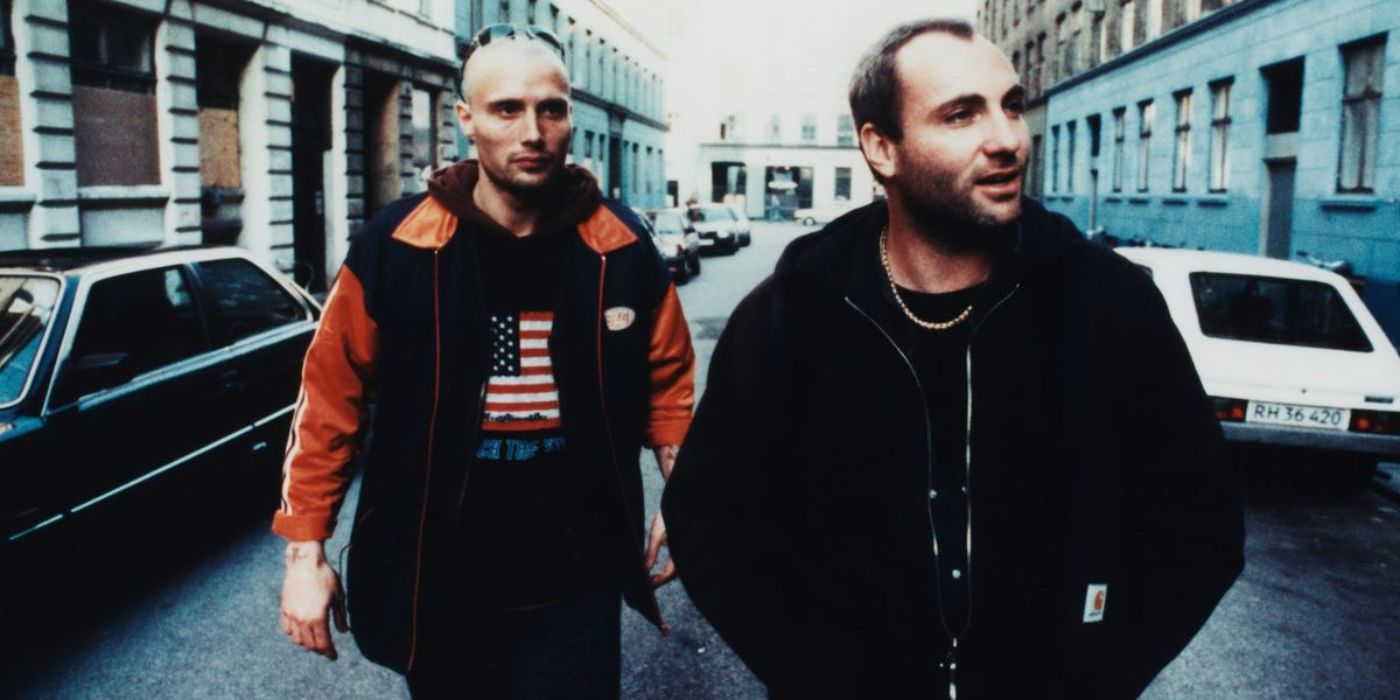
As a huge film buff, I always say the original Pusher and its two follow-ups are easily one of the greatest gangster trilogies ever made. It’s incredible to think that the first Pusher, a Danish film from 1996, was actually Nicolas Winding Refn’s very first feature! It was such a bold start to a career that would later give us films like Bronson, Drive, and Only God Forgives. Years later, around 2004, Refn was really inspired by the amazing TV shows of the early 2000s – things like The Wire and The Sopranos – and decided to expand his Pusher story into a series. That’s how we got Pusher 2 in 2004, and then Pusher 3 quickly followed in 2005.
The Pusher trilogy offers a gritty look at Copenhagen’s drug trade, following a different dealer in each film. These aren’t just criminals; they’re also struggling with addiction themselves, which is a central theme. Like The Godfather, the films become increasingly intense as the series progresses. While each movie tells a complete story, the impact is greater if you watch them in order.
Pusher Tells Frank’s Story
The film Pusher follows Frank, a drug dealer who enjoys partying with his friend and fellow criminal, Tonny. When Frank runs into an old jail acquaintance who wants to buy a large amount of heroin, he manages to secure the deal from his supplier, Milo, despite already being in debt. However, a police raid interrupts the transaction, forcing Frank to ditch the drugs. Now owing Milo even more money, Frank races against the clock to come up with the funds before the day is over.
Meanwhile, he manipulates a young sex worker with false promises, driving her to her breaking point. He also severely beats Tonny, causing a brain injury (as seen in Pusher 2), because Tonny had reportedly told the police something about Frank. While these details might seem like spoilers, the film is so fast-paced and eventful that knowing them won’t significantly detract from a first-time viewing.
Unlike many crime films, Pusher doesn’t glamorize criminal activity or drug use. It’s a gritty and realistic look at the lives of those involved, focusing on their flaws and using a natural, unpolished visual style. While fans of classic mafia movies might find its independent approach different, it’s a compelling film for anyone seeking an authentic portrayal of the Danish criminal world. Despite being made on a low budget, Pusher boasts excellent art direction, cinematography, and, most importantly, strong performances. Kim Bodnia and Mads Mikkelsen have great chemistry as the drug-dealing partners, Frank and Tonny. Zlatko Burić is captivating as Milo, Laura Drasbæk delivers a moving performance as Vic, and Slavko Labović is genuinely frightening as Milo’s enforcer, Radovan.
Pusher 2 Tells Tonny’s Story
Following the events at the end of the first film, Tonny takes center stage in Pusher 2 after Frank’s disappearance. Like its predecessor, the movie focuses on a criminal struggling with bad luck, drug use, and pressure from those above him. While the cast isn’t quite as star-studded as the original, the lead actor in Pusher 2 delivers a stronger performance. Though Kim Bodnia was excellent in Pusher, Tonny is a more compelling character thanks to both better writing and the addition of a family storyline. The film explores Tonny’s desire for his father’s approval, adding a new emotional dimension to the story.
After learning he’s become a father, Tonny attempts to climb the ranks in the criminal underworld to support his child. Similar to the first Pusher film, Pusher 2 ends with a surprising act of betrayal. While keeping the same feel, themes, and story structure as the original, the sequel is not only a worthy follow-up – many consider it even stronger, offering a more in-depth look at its characters.
Compared to the first Pusher film, Pusher 2 explores deeper themes by focusing on family history, the responsibilities of parenthood, and personal growth. Tonny’s story is the most emotionally resonant of the trilogy, as many viewers can connect with his desire to impress his father, the challenges of living up to a parent’s mistakes, or the difficulties of unexpected parenthood. Despite his flaws and poor choices, the film ultimately shows that Tonny still possesses a good heart.
Pusher 3 Follows the Story of Milo
In the Pusher films, Milo is a drug dealer who repeatedly causes trouble for those who owe him money. He first harasses Frank in the original Pusher, then Kurt and others in Pusher 2. Notably, he inquires about Frank’s whereabouts in Pusher 2, suggesting Frank may still be alive. Pusher 3 begins with Milo attending an N.A. meeting, revealing he’s been sober for five days. This film portrays Milo as a now-powerful and intimidating gangster, but one facing the same desperate situation as Frank and Tonny in the previous films. Although Milo tries to run his drug business while staying sober, the stress of his daughter’s birthday and some failed deals quickly overwhelm him, causing him to relapse.
Radovan, a character from the first Pusher film, unexpectedly reappears in Pusher 3 after Milo violently confronts one of his colleagues. Beyond Radovan, Milo, and Kurt’s quick cameo, most of the characters in Pusher 3 are new faces. The film revisits the theme of family, as seen in Pusher 2, with Marinela Malisic delivering a standout performance as Milo’s daughter, Milena. Ilyas Agac and Ramadan Huseini also shine as the pushers who work with Milo, much like Mads Mikkelsen did as the volatile lead in the earlier films.
The third film in the series continues to follow the main character’s unfortunate journey, but Pusher 3 takes the violence and the story’s intensity to a new level. It’s a strong film on its own, and surprisingly, it actually enhances the previous two installments. By giving viewers a deeper understanding of Milo, the film retroactively adds a new layer of interest to the earlier parts. He evolves from a simple villain in the first film, to a supporting character in the second, and finally becomes a complex, tragic hero in the third. This arc perfectly portrays Milo as a classic mobster who would only leave the criminal life in death. He’s always aware and always in control, maintaining his power by remaining constantly vigilant. After seeing Pusher 3, fans will want to revisit the entire trilogy, now with a complete understanding of Milo’s true character.
As a movie fanatic, I can tell you that Nicolas Winding Refn’s Pusher trilogy is truly something special – unlike any other gangster films I’ve seen. He’s right up there with other brilliant Danish directors like Lars von Trier and Susanne Bier – they all have a unique voice. Honestly, each Pusher film is fantastic, and I’d even argue they get better with each installment, showing how much Refn grew as a filmmaker. You can really see his style developing over the nine years it took to make the whole thing; it’s instantly recognizable no matter who’s behind the camera. Speaking of which, Morten Søborg did amazing work as the cinematographer. You can trace Refn’s directorial flair all the way back to the very first Pusher in ’96.
Read More
- Surprise Isekai Anime Confirms Season 2 With New Crunchyroll Streaming Release
- HBO Max Just Added the Final Episodes of a Modern Adult Swim Classic
- Crimson Desert’s Momentum Continues With 10 Incredible New Changes
- Frieren: Beyond Journey’s End Gets a New Release After Season 2 Finale
- Pragmata Shows Off Even More Gorgeous RTX Path Tracing Ahead of Launch
- All 7 New Supes In The Boys Season 5 & Their Powers Explained
- Preview: Sword Art Online Returns to PS5 as a Darker Open World Action RPG This Summer
- ‘Project Hail Mary’: The Biggest Differences From the Book, Explained
- Solo Leveling’s New Character Gets a New Story Amid Season 3 Delay
- Coronation Street airs horrifying discovery for Summer Spellman about villainous Theo in early ITVX release
2026-04-14 17:38