Bitcoin clings to the threshold of seventy-five thousand, as if the cold winds of the market steppe have blown through the ticker. The momentum that drove it toward seventy-nine thousand in recent days has slackened, not vanished. The recovery is real enough to be observed, like frost on a window, but not decisive enough to declare spring. And as the market holds its breath, a GugaOnChain report appears, a stark memorandum pointing to a price zone that the grand numbers themselves seem to eye with wary seriousness.
The report marks the zone from sixty-five to seventy thousand as a potential pocket of liquidity, the very place where institutions have long leaned during corrective gusts. With Bitcoin’s three-day retreat dragging that range back into view, the old framework for judging whether the “smart money” has truly taken notice rises again on the horizon, like a tired guard at a ruined post.
The analytical method proposed is not a single signal but a cord of three strands. The first rests on a metric that measures the pain of the retail crowd. When recent buyers are forced to sell at a loss-when those who bought in the last months capitulate at prices below their entry-the STH-SOPR dips below 1.0. This reading is not merely bearish gloom. It is the precise condition that history has recorded as the moment when institutional players begin to fill positions, absorbing the cheap liquidity born of retail panic, as if the market itself were a hungry mouth.
The bleeding of the weak hands and the purchasing of the smart money are not enemies; they tend to march in step. In markets, they march together, and recognizing their simultaneous march is the bedrock of the framework the report builds.
Two More Signals. When All Three Align, the Move Becomes Inevitable
The STH-SOPR reading confirms retail pain. Yet pain alone does not suffice to validate institutional accumulation – it must be accompanied by capital and position that transform a test of support into a directional shock. The second and third pillars of the GugaOnChain framework provide those confirmations.
The stablecoin supply ratio tracks the firepower waiting on the sidelines. When large inflows of USDT flood into Binance-the exchange that handles the largest share of global Bitcoin volume-it signals that institutional capital has been loaded and stands ready to deploy, like troops waiting at the gate.
That influx must coincide with a divergence in order flow: retail traders opening leveraged short positions in derivatives while institutions silently accumulate the actual asset in spot markets. The CVD captures that split in real time. When derivatives scream shorting while spot buying quietly dominates, the groundwork for a squeeze begins to form beneath the surface, a knot tightening unseen by the casual observer.
The funding rate completes the picture and supplies the trigger. When the 30-day funding rate lingers in persistent negative territory between -0.015% and -0.020%, short sellers become dangerously overleveraged. They have borrowed heavily to bet against the price-and in doing so, they have forged the directional fuel that makes a violent short squeeze not merely possible but mechanically inevitable when institutional buying finally presses the button.

The convergence of all three – retail capitulation in spot, stablecoin firepower confirmed on Binance, and extreme negative funding guaranteeing overleveraged shorts – is the sieve that separates noise from signal. When they align, the directional shock the report describes does not arrive gradually. It arrives all at once, like a door being slammed from a room that refuses to be ignored.
Bitcoin Tests Range High As Recovery Meets Overhead Resistance
Bitcoin is hovering near $76,000, pressing into a resistance zone that has relentlessly capped upside attempts since the February breakdown. After a base formed between $64,000 and $68,000, the price has climbed in a controlled recovery, stitching together a sequence of higher lows that hints at a sturdier short-term structure. Yet that recovery now meets a point of coercion and consequence.
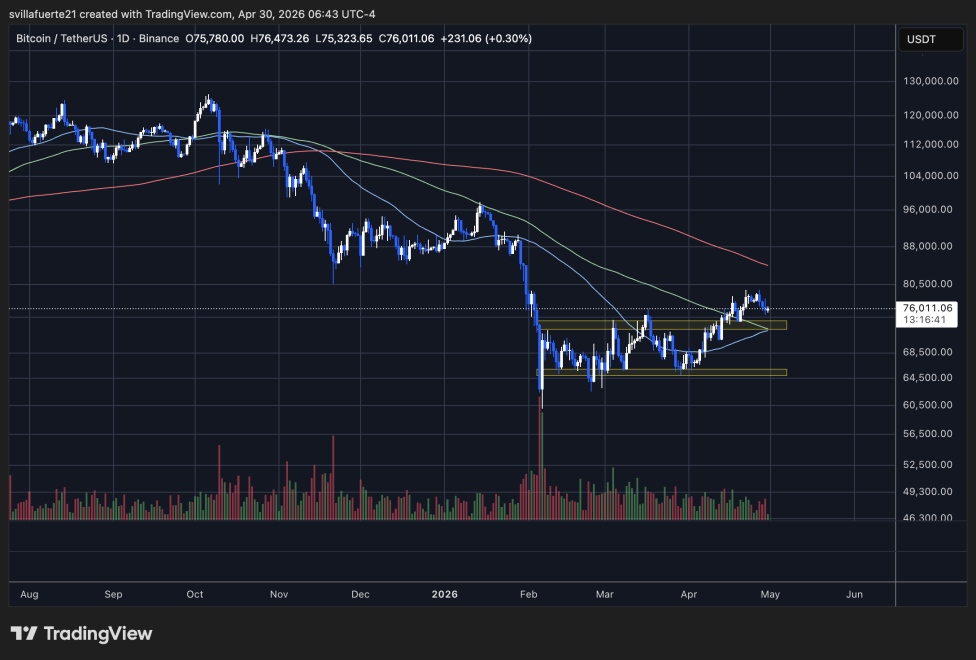
The $74,000-$76,000 region stands out as a clear supply zone. It formerly offered support before the breakdown and now acts as resistance, with multiple rejections confirming the presence of sellers. This aligns with the 100-day and 200-day moving averages, both trending downward and converging above the current price, reinforcing the broader bearish bias the cold wind carries.
Momentum slows as the price approaches this level. Recent candles show smaller bodies and reduced follow-through, suggesting that buyers are losing strength as they confront overhead supply. Volume patterns back this interpretation. The spike during the February selloff marked capitulation, but the subsequent recovery has occurred on relatively moderate volume, signaling that conviction behind the move remains frayed and uncertain.
Structurally, Bitcoin remains range-bound between $64,000 support and $76,000 resistance. A decisive break above this zone would shift momentum and open a path toward $80,000, while rejection here risks a rotation back into the lower range and a return to the cold discipline of the Balkans of price.
Read More
- 10 Greatest Manga Endings of All Time
- Review: Final Fantasy Tactics: The Ivalice Chronicles (PS5) – Still the Benchmark for Turn-Based Tactics
- Mark Zuckerberg & Wife Priscilla Chan Make Surprise Debut at Met Gala
- GBP CNY PREDICTION
- Elon Musk’s Mom Maye Musk Shares Her Parenting Philosophy
- Forza Horizon 6 Car List So Far: Confirmed Highlights, Cover Cars, DLC, and Rewards
- Miranda Kerr Shares “Quick” Procedure She Got Before Met Gala 2026
- The WONDERfools ending explained: What happened to the Child of Eternity?
- Ranking the 5 Best Spring 2026 Anime So Far (Mid-Season Update)
- Sony Plans to Start Shooting Horizon Movie in 2026, with 2027 Release Planned
2026-05-01 13:42