In a move as sudden as a Moscow winter, the United States Senate has decided to save its members from themselves. On a Thursday that will henceforth be remembered as the “Day of Moral Clarity,” our esteemed lawmakers unanimously agreed to ban themselves from the thrilling world of prediction markets. Oh, the irony of those who shape policy finally realizing they shouldn’t bet on it!
Key Takeaways:
- Sen. Bernie Moreno, with the zeal of a man who’s just discovered his moral compass, led the charge to pass this ban on April 30, 2026.
- Prediction platforms like Polymarket and Kalshi saw volumes surge as if the markets themselves were betting on the ban’s failure.
- Senate Rule XXXVII now ensures that the 100 members will no longer gamble on the very events they influence, lest they lose the last shred of public trust.
Senator Bernie Moreno (R-OH), a man who apparently has nothing better to do than police his colleagues’ “side hustles,” introduced this resolution with all the gravitas of a man who’s just discovered a new moral high ground. The resolution, which took effect immediately, targets the burgeoning sector of event contracts. Platforms like Polymarket and Kalshi, which had become the digital playgrounds for those who confuse governance with gambling, are now off-limits.
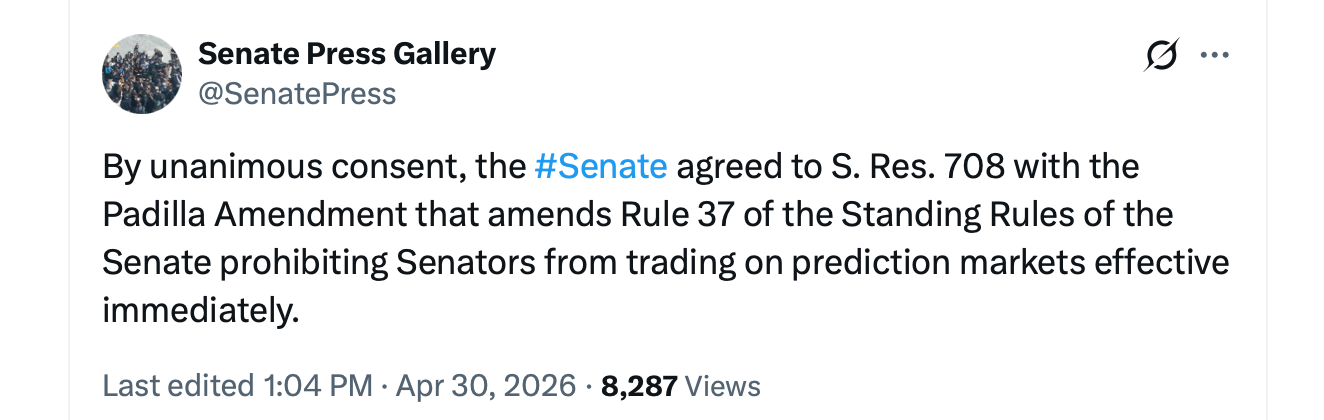
By amending Rule XXXVII, the Senate has effectively cordoned off its members from these digital dens of iniquity. The new language is as clear as a Chekhovian subtext: no senator shall enter into contracts where payments depend on the occurrence or nonoccurrence of specific events. In other words, no more betting on whether the next bill will pass or if the President will finally remember all 50 states.
Moreno, with a straight face, framed this as a necessary step to restore public integrity. He declared that treating the Senate as a vehicle for personal gain is a “fundamental betrayal of the American people.” One wonders if he’s ever met the American people-they’re not exactly known for their naivety.
The push for the ban was accelerated by two scandals in late April that shook the industry like a Chekhovian family secret. On April 22, the regulated exchange Kalshi fined three congressional candidates for betting on their own races. The audacity! As if running for office weren’t already a gamble.
Just one day later, a U.S. Army Special Forces soldier was arrested for allegedly using classified intelligence to win over $400,000 on Polymarket. The bet? A military operation involving Venezuelan leader Nicolás Maduro. One can almost hear the soldier’s defense: “But sir, I was just hedging my career risks!”
These incidents provided the political momentum needed for a unanimous voice vote. While the Senate acted internally, Democratic lawmakers are simultaneously pressuring the Commodity Futures Trading Commission (CFTC) to implement broader industry-wide safeguards against insider trading. Because, of course, when the Senate sneezes, the CFTC catches a cold.
The scope of this rule change is limited exclusively to the 100 members of the Senate. It does not currently apply to members of the House of Representatives, congressional staffers, or officials within the executive branch. After all, why should the Senate have all the fun-or all the shame?
Despite its narrow application, the move signals a shift in how Washington views the intersection of decentralization and governance. As prediction markets become more liquid, the potential for “information leakage” from the halls of power has become a primary concern for regulators. One might say the Senate is finally acknowledging that not all leaks are created equal.
Industry leaders at Kalshi and Polymarket have already begun implementing self-imposed restrictions on political figures. However, the Senate’s proactive rule change provides a formal ethical boundary that was previously a legal gray area. Because nothing says “we’re serious” like a rule that’s not actually a law.
The resolution includes a minor carve-out for traditional insurance contracts, ensuring that standard financial planning remains unaffected. This adjustment was made following a proposal by Senator Alex Padilla (D-CA) during the drafting process. Because even in the midst of moral grandstanding, one must consider the practicalities of life insurance.
Violations of the new rule will now trigger immediate review by the Senate Ethics Committee. While the ban is not a statutory law, the unanimous consent reflects a rare moment of bipartisan agreement on the need for transparency in the digital age. Or, as one might say, a rare moment of agreement that they don’t want to be caught red-handed.
As the 2026 election cycle continues, the focus now shifts to whether the House will follow suit. For now, the Senate has sent a clear message: the Capitol is no place for speculators looking to hedge their bets on the future of the country. Though, one suspects, the speculators will simply find another game to play.
Read More
- Marvel Officially Confirms Deadpool’s Most Brutal Redesign
- Welcome to Demon School! Iruma-kun season 4 release schedule: When are new episodes on Crunchyroll?
- Nintendo Switch 2 Reportedly Getting Remake of One of the Best PS3 and Xbox 360 Games
- Michael Jackson Biopic’s Record-Breaking Debut Unseats 2026’s Biggest Box Office Hit On U.S. Chart
- Crunchyroll Confirms New Isekai Anime Releases for 2026 and Beyond (With Major Returns)
- The Boys Season 5, Episode 2’s Soldier Boy Ending Twist Changes Everything for Homelander & Butcher
- The Fairly OddParents’ Creator Reveals Who Timmy Ended Up With
- Gold Rate Forecast
- 5 Best Open-World Games You Can Beat In A Weekend
- 10 Movies That Were Banned in Different Countries For Random Reasons
2026-04-30 22:27